Achraf Tchatikpi 10/09/2016 Exploratory Essay FIQWS 2PM
Gentrification: Displacement of African American communities
Suburban areas all over the united states, with their ever changing economies, demographics and structures; have brought fortune to some and hardships to others when it comes to housing. Many will assume it’s a positive movement and development of the less fortunate neighborhood. Why would anyone be against improvement? The truth is, it’s the culture of a people, the displacement of an entire community; simply because they could no longer keep up with their rent. When we put Harlem under the microscope, we see a perfect example of gentrification. The photograph from True News (fg.1) and the passage of Leslie Gordon Goffe, both, once more give voice to the ignored community of Harlem African Americans.
Fig.1 is taken from True News Article; the photograph depicts what resembles a protest. The protesters appears to be minorities groups. In the foreground, the main characters are three men, holding a poster reading “ We are the heart of Harlem No ethnic cleansing in Harlem”. The picture is captured in black and white, giving a serious mood to the scene. There are many
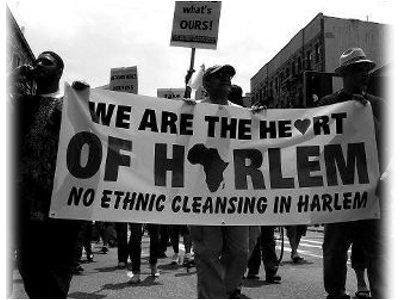
more protesters in the background. Although the poster is blocking their faces, you can still see Fig1. A demonstration against the gentrification in Harlem (True News) their cardboards held up high in the distance. The scene is set in a suburb; on the top right handed corner, we see a brownstone of barely 5 stories. The building look a bit worn out, and we hardly see any building as tall in the background. An interesting fact is on the Poster, the writer replaced the letter “A” in “Harlem” with the drawing of the African Continent.
New African Magazine With commercials giants like Target, Costco, H&M, Best Buy and Burlington taking over the local businesses and monopolizing the market. The photographer wanted to draw the viewer’s attention towards the impact on African American communities. We quickly grasp what is the fuss about in fig.1, just by reading the poster. These are community members expressing their indignation towards gentrification in their community. Judging by the infrastructures, we can infer that this is taking place in Harlem. There are no skyscrapers or crazy foot traffic so we can safely conclude, that this is happening in a suburb. The men marching have a really concerned look on their faces. The height of the cardboards in the background elucidates the commitment of the protesters to really put a stop on this. It also grandstand the heat of the moment and the energy of the protest.
The African American long term residents and the minority populace is fed up with the city’s blind eye on their current situation. “Something is changing in New York’s Harlem and other black neighborhoods, and it is all to do with the gentrification of the once predominantly black areas. Leslie Gordon Goffe writes on how the hubs of black soul – from barbershops to restaurants – are increasing being “whitewashed”. This is a sign of the times.” living in the suburb, it is impossible not to feel the gentrification. Along with the transplanting, investors are also answering to the call. Multiple luxury condos are spawning in Harlem. Bizarrely next to the casual 5 stories brownstones that have been on these lands for decades. Although their future is highly uncertain, long dated community members are counting on their survival.
Gordon has more racial approach to the issue. He states that gentrification is not only happening in Harlem, but on other Black neighborhood all over America. He goes on to say that African American neighborhood are being “whitewashed”. As if it is a conspiracy to get rid of the Black suburbs, remodel them, and give it back to the whites. Gordon also mention how the barbershops and restaurants are being modified to the appeal of white customers. Developers, investors and the gentrifying commonwealth will look at these circumstances as a positive change. For them it is business, it is good innovation, it is taking the inner city and transforming it and make it more desirable. Folks like Gordon regard these changes more like a racial invasion. An attack on African communities, a threat to their survival.
There is more to Gentrification than just its economic convenience or the bargains it brings to the well off . the social aspect of the topic is very too often ignored. The photograph True News shows us how many members of these community are unfaltering when it comes to preserving their places in a community that they’ve been present in for decenies. They are taking actions and will not accept to be priced out of their homes. Leslie Gordon words, also represent a perspective that many African Americans have of gentrification. The Whites forcing them out of their homes again with complete disregards of their culture of community. The social aspect of urbanization is what is almost always least dealt with.
Work cited
- Gordon, By Goffe Leslie. “The Harlem Gentrification: From Black to White.” “” by Goffe, Leslie Gordon . N.p., n.d. Web. 12 Oct. 2016.
- Journalist. “Gentrification and Race 676.” True News (The Bund): . N.p., 1970. Web. 11 Oct. 2016.
- Roberts, Sam. “No Longer Majority Black, Harlem Is in Transition.” Nytimes . N.p., n.d. Web. 05 Jan. 2010.
 Ash's Literary Works